
You don't need a domestic worker with a clinical degree as much as you need one with a quiet, unshakable spirit. Finding a dedicated helper for children with autism is less about technical skills and more about discovering a person who can remain calm when the world feels loud. If you've spent your nights wondering if anyone else could ever truly understand your child’s world, or if you’re destined to carry the exhaustion of 24/7 caregiving alone, you aren't imagining the weight of this decision. It's a heavy burden to worry that a misunderstanding during a meltdown might lead to a helper quitting because the role feels too complex.
We believe that matching your family with the right support is a journey of finding compatibility rather than just checking boxes. You deserve a home environment where you can finally breathe, knowing your child is supported by someone who sees their unique needs with compassion. This guide explores how to identify that rare spark of patience, provide specialized training, and integrate a helper who feels like a natural extension of your family. From navigating the S$60 concessionary levy to building long-term trust, we'll show you how to secure the reliable support your household needs to thrive in 2026.
Key Takeaways
- Learn why a helper for children with autism serves as a vital bridge between therapy sessions and a stable, nurturing home environment.
- Discover the "Observation Test" and other practical ways to identify essential traits like unflappability and natural empathy that don't appear on a standard bio-data.
- Navigate Singapore’s financial support landscape, including how to qualify for the Home Caregiving Grant and the concessionary MDW levy rate.
- Master the first 30 days of integration by using visual schedules and clear onboarding techniques to build a reliable care partnership.
- Understand how a chemistry-first matching philosophy prioritizes human connection to ensure your helper becomes a long-term, trusted extension of your family.
Understanding the Role of a Domestic Helper for Children with Autism
When you invite a helper into your home to support a neurodivergent child, the job description changes entirely. It's no longer just about sparkling floors or a cooked meal; it's about the emotional architecture of the household. A dedicated helper for children with autism serves as a vital bridge between the structured sessions of a therapist and the unpredictable flow of daily life. While some might view this as a purely transactional employment, we see it as the creation of a supportive partnership that prioritizes the child’s sense of safety. By gaining a foundational Understanding Autism Spectrum Disorder, a helper can transform from a standard domestic worker into a specialized companion who understands why certain routines cannot be broken.
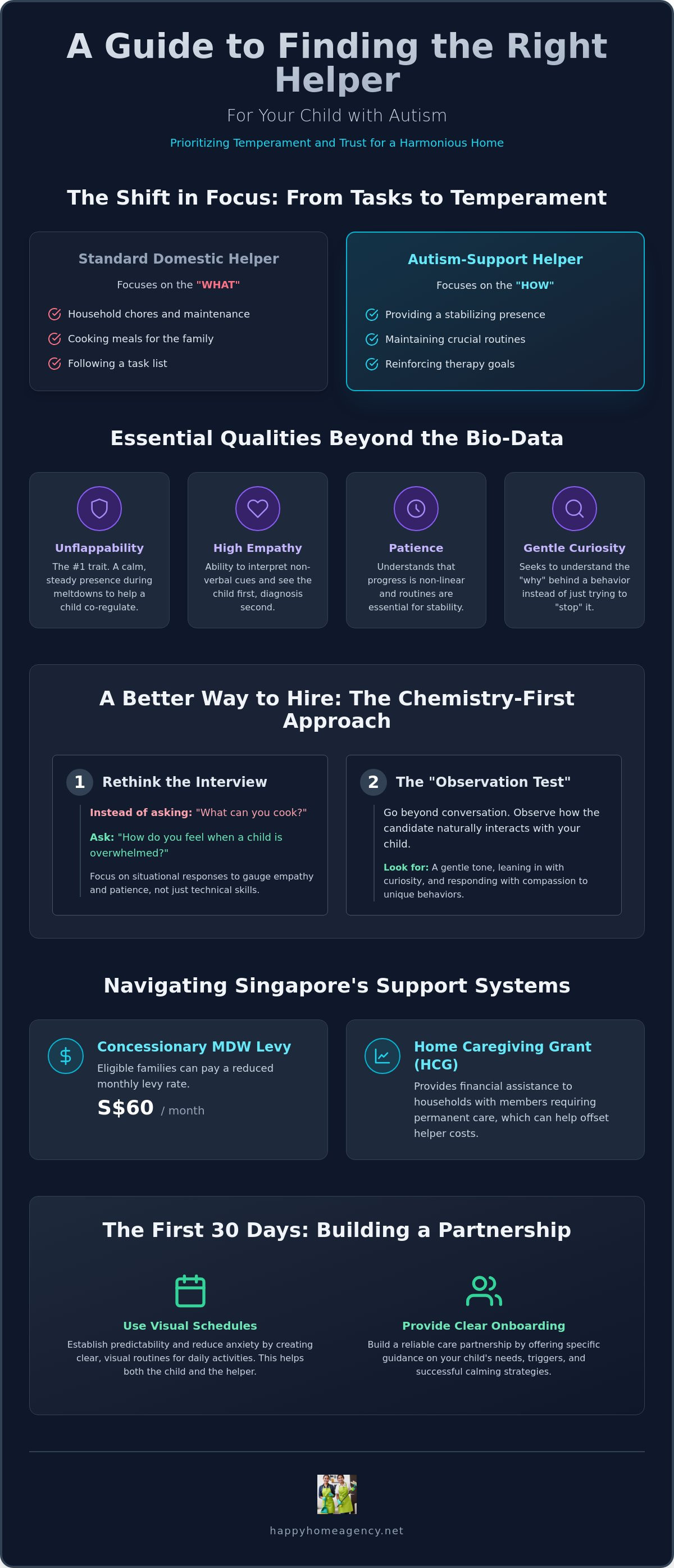
If a standard helper focuses on the "what" of housework, an autism-support helper focuses on the "how" of interaction. You don't necessarily need a medical professional with clinical certifications to achieve harmony at home. Instead, you need someone trained in the nuances of neurodiversity who can provide a stabilizing presence. This person doesn't just manage symptoms. They foster an environment where the child feels understood and the parents finally have the space to rest. When the right match is made, the result is a significant reduction in parental burnout and a renewed sense of family harmony.
The "Presence" Factor: Why Temperament Trumps Certificates
The most valuable asset a helper can possess isn't a certificate, but a "calm energy" that remains steady during sensory meltdowns. If the helper stays grounded, the child has a better chance of co-regulating. This requires a high level of empathy to interpret non-verbal cues that others might miss. A helper’s ability to observe a child’s subtle shifts in mood is far more impactful than their ability to follow a rigid manual. It is a quiet strength. It is a steady hand. We look for individuals who naturally possess this unflappability, as it's the foundation of long-term trust.
A Vital Part of the Intervention Team
A helper for children with autism acts as a consistent anchor in a world that often feels overwhelming. They reinforce goals set by therapists during everyday moments, like practicing communication during bath time or maintaining focus during a meal. This consistency ensures that the progress made in a clinic doesn't disappear the moment the child walks through the front door. An autism-support helper is a caregiver whose primary role is to maintain the child’s daily routine while providing the emotional regulation necessary for a peaceful home life. By becoming a natural extension of your family's care team, they provide the reliable support that allows everyone in the home to thrive.
Essential Qualities to Look For: Beyond the Bio-Data
A standard bio-data tells you where someone has worked, but it rarely tells you who they are in a moment of crisis. When searching for a helper for children with autism, you must look for "unflappability" above all else. This isn't a skill that can be easily taught; it is a temperament. It's the ability to remain a calm, steady presence while a child navigates a world that feels too loud or too bright. If a candidate has ten years of experience but lacks this core stillness, the partnership may struggle when the daily routine meets the reality of neurodivergent life.
We often recommend an "Observation Test" during the final stages of hiring. Rather than just talking in a living room, observe how the candidate naturally reacts to your child’s unique behaviors. Do they look for your child's eyes? Do they respond with gentle curiosity when a repetitive movement occurs? A helper for children with autism who leans in with empathy rather than pulling back in confusion is showing you the heart-centered approach your home needs. This natural chemistry is the foundation of the trust you are trying to build. It's about finding a person who sees the child first and the diagnosis second.
The Screening Process: Identifying High-Empathy Candidates
During the interview, move past "What can you cook?" and focus on "How do you feel when a child is overwhelmed?" Ask for specific examples of when they handled "difficult" behaviors in the past. If their answers focus solely on discipline or "stopping" the behavior, it might be a red flag. You want to hear about patience and the search for an underlying cause. If the candidate seems rigid or overly focused on following a strict list of chores, they might lack the flexibility required for an autism-friendly home. A successful match often feels right in your gut during that first meeting. If you're struggling to find this connection, our special needs care placement specialists can help bridge the gap by prioritizing human chemistry over paperwork.
Specialized Skills for an Autism-Friendly Home
While a growth mindset is the best predictor of success, certain baseline knowledge is incredibly helpful. A helper should understand sensory triggers like noise or tactile sensitivities to avoid accidental overstimulation. They must also learn the critical difference between a sensory meltdown and a goal-oriented tantrum. Knowing that a meltdown requires quiet support rather than a "time-out" changes the entire household dynamic. Familiarity with visual aids or the Picture Exchange Communication System (PECS) allows the helper to become a true partner in your child's development. For families who want to provide their helpers with even more context, we suggest reviewing CDC Resources for Families to build a shared language of care and compassion.
Navigating Singapore’s Support Systems and Grants
The financial landscape of caregiving shouldn't be a source of stress in an already complex journey. While the emotional search for a compatible companion is paramount, understanding the practical support available in Singapore allows you to focus on your child’s well-being. If you're hiring a helper for children with autism, the government provides several pillars of support to ensure your family remains resilient. These grants are designed to recognize the extra effort required in neurodivergent care and to make long-term support more sustainable for local households.
When you begin this process, it's helpful to look at the broader picture of how to find the right caregiver who can integrate into these systems. A well-informed approach ensures you aren't just finding a person, but also securing the resources needed to keep that person well-trained and supported. From levy concessions to training subsidies, these financial tools act as a foundation for a stable home environment.
Financial Assistance for Special Needs Care
The Home Caregiving Grant (HCG) is a significant resource for families. As of April 2026, the HCG has been enhanced to provide a maximum of S$600 per month for households with a per capita monthly income of up to S$4,800. This tiered grant helps offset the costs of hiring a helper or paying for therapy. Additionally, families caring for a child with special needs qualify for the Migrant Domestic Worker (MDW) Levy Concession. This reduces your monthly levy from the standard S$300 to just S$60, providing immediate relief to your monthly overhead.
To further support the helper’s growth, the Caregivers Training Grant (CTG) provides S$400 annually. This grant is specifically for attending approved caregiving courses, ensuring your helper stays updated on the best practices for supporting your child’s unique needs. We often help families navigate these applications as part of our specialized care placement services.
Official Training Pathways in Singapore
Upskilling is a continuous journey. The Agency for Integrated Care (AIC) works closely with various Social Service Agencies (SSAs) to offer courses tailored to neurodiversity. These programs teach helpers how to manage sensory sensitivities and reinforce positive behaviors. By utilizing the CTG, you can enroll your helper in these specialized modules without a heavy financial burden. At Happy Home Agency, we understand that the administrative paperwork for these grants can feel overwhelming. Our team assists with the necessary documentation, ensuring you can access every available subsidy while you focus on the heart of the matter: your child’s happiness and your family’s peace of mind.
Creating a Successful Care Partnership at Home
The arrival of a new helper for children with autism marks the beginning of a delicate integration process that goes far beyond traditional household training. It isn't just about showing where the groceries are kept or how the laundry is sorted. Instead, it's about inviting a new person into your child’s delicate sensory world with intention and grace. The first 30 days are the most critical. During this time, the focus should shift from task completion to relationship building, allowing the helper to become a familiar, non-threatening presence in your child’s daily life.
We advocate for a dedicated "Shadowing Phase" during the initial weeks. During this period, you act as the lead caregiver while the helper observes your techniques, your tone of voice, and your child’s unique reactions. If you use specific phrases to de-escalate a situation, let the helper hear them. If you use a particular touch to provide comfort, let them see it. Modeling these behaviors provides a practical blueprint that no manual can replicate. To keep everyone on the same page, we recommend establishing a daily communication log. Use it to record small wins, like a successful transition between activities, and challenges, such as a difficult reaction to a loud noise. This log ensures that the care partnership is built on shared data and mutual understanding.
Sensory Onboarding: Explaining Your Child’s World
To set your helper up for success, you must create a "Trigger Map" of your home. This list should include sensory sensitivities that might seem ordinary to others but are overwhelming for your child. If the sound of a vacuum cleaner or the smell of certain cooking spices causes distress, the helper needs to know this before they begin their chores. Establish a "Safe Space" protocol so the helper knows exactly where to guide the child when the world feels like too much. A helper’s primary job during a meltdown is calm presence, not correction. By focusing on co-regulation rather than discipline, the helper becomes a source of safety rather than a source of stress.
Preventing Burnout: Supporting Your Helper
High-needs caregiving is emotionally and physically demanding. To ensure the longevity of this relationship, you must prioritize your helper’s well-being alongside your child’s. Ensure they have adequate "quiet time" to recharge away from the intensity of the role. If a helper feels seen and appreciated for their patience, they're far more likely to commit to your family for the long term. If you ever feel the relationship is straining under the complexity of the care, don't wait for a crisis to occur. Our 365-Day Employer Care™ is designed to provide the mediation and ongoing support needed to keep your household in harmony.
How Happy Home Agency Finds Your Family’s Perfect Fit
Choosing a helper for children with autism isn't a task to be rushed; it's a connection to be nurtured. Many agencies treat recruitment as a volume-based transaction, focusing on how many bio-data they can present in an afternoon. We take a different path. Our "Wise Matchmaker" philosophy is built on the belief that human chemistry is far more predictive of success than a list of skills on paper. We look for the intangible qualities that make a house feel like a home, ensuring that the person you welcome into your private space is someone who brings peace, not just a pair of hands. Families across Singapore trust our Lucky Plaza team for these complex placements because they know we value stories over data points.
We understand the quiet anxiety that comes with letting a stranger care for your neurodivergent child. Our role is to act as a protective guide, screening for individuals who possess a natural, unteachable stillness. This methodical approach ensures that the relationship is built on a foundation of stability and emotional security from day one. By prioritizing compatibility, we help you find a partner who feels like a natural extension of your family unit.
Our Heart-Centered Matching Process
During our interview process, we look deep into a candidate’s "patience profile." It isn't enough for a helper to say they are patient; we look for the way they describe past challenges and their natural instinct to offer compassion during a crisis. We also act as a vital cultural bridge. Many helpers come from backgrounds where neurodiversity is not openly discussed, so we take the time to help them understand the specific support systems and expectations within a Singaporean household. This preparation ensures they aren't just entering a job, but are ready to integrate into your child’s world. You can learn more about Our Specialized Placement for Your Family’s Unique Needs to see how we tailor our search to your specific household dynamics.
A Year of Support: The 365-Day Employer Care™
The journey doesn't end on the day your helper arrives. In fact, that's when our commitment to your long-term peace truly begins. We introduced 365-Day Employer Care™ because we know that the first year of integration can bring unexpected hurdles. If a misunderstanding occurs or if your child’s needs evolve, our "Empathic Experts" are here to provide mediation and guidance. We don't just solve conflicts; we help both parties communicate with more heart and clarity. This ongoing support prevents the burnout and high turnover that many families fear, creating a sustainable environment where everyone can thrive. Speak with our Wise Matchmakers today for a personalized consultation and let us help you find the reliable, compassionate support your child deserves.
Building a Brighter Future for Your Family
Securing the right helper for children with autism is a journey toward reclaiming your family's peace. It's about looking beyond a standard list of chores to find a companion who offers a steady, calm presence during your child's most challenging moments. By prioritizing human chemistry and leveraging Singapore's supportive grants, you can create a household environment where your child feels safe and you feel truly supported. You deserve a home that feels like a sanctuary, not a source of stress.
At Happy Home Agency (EA Licence 06C4290), our specialized screening for neurodiversity support ensures we find the rare individual who truly understands your child's world. We don't just facilitate a placement; we commit to your long-term success through our 365-Day Employer Care™ program. This provides the ongoing mediation and heart-centered guidance necessary for a lasting, harmonious relationship. Find a compassionate helper for your child today and take the first step toward a more restful, reliable home life. You don't have to carry this weight on your own.
Frequently Asked Questions
Can a domestic helper really handle a child with severe autism?
Yes, a domestic helper can effectively support a child with severe autism if they possess the right temperament and receive specific guidance. Success depends on finding a candidate with high unflappability who prioritizes emotional regulation over strict discipline. While they aren't clinical therapists, their role as a consistent anchor provides the routine stability necessary for high-needs care.
Do I need to pay a higher salary for a helper with autism experience?
Experienced helpers often command a higher monthly salary in the Singapore market due to their specialized skillset. However, a growth mindset is often more valuable than a list of previous employers. We focus on finding a helper for children with autism whose patience profile matches your child's needs, ensuring the relationship is sustainable and fair for both parties.
What government grants are available in Singapore for helpers of children with autism?
Families can access the Home Caregiving Grant (HCG), which provides up to S$600 monthly for eligible households as of April 2026. You also qualify for the concessionary MDW levy rate of S$60 per month. These subsidies are designed to help local families manage the additional costs associated with specialized domestic support without placing a heavy burden on the household budget.
Is there specific training available for my helper to learn about autism?
Yes, the Agency for Integrated Care (AIC) offers various courses through Social Service Agencies specifically for neurodiversity support. You can utilize the S$400 annual Caregivers Training Grant (CTG) to offset the costs of these programs. This ensures your helper stays updated on the best ways to support your child's unique sensory and behavioral needs while building their own confidence.
What should I do if my helper is scared of my child’s meltdowns?
Education and clear protocols are the best ways to alleviate a helper's fear during a sensory meltdown. If your helper understands that a meltdown is an overwhelmed response rather than intentional bad behavior, they can focus on providing a calm presence. Establishing a Safe Space protocol helps them feel empowered and prepared rather than helpless when your child is struggling.
How long does it typically take to find a helper for special needs?
Finding a truly compatible match typically takes longer than a standard hiring process because we prioritize chemistry over bio-data. We believe in getting it right rather than getting it done fast. This methodical approach ensures the helper for children with autism you welcome into your home is a long-term partner who truly belongs in your family unit.
Can Happy Home Agency help if the first match doesn’t work out?
Absolutely, our 365-Day Employer Care™ program is specifically designed to support families if the initial integration feels difficult. We provide mediation and guidance to resolve conflicts and help the helper adjust to your household dynamics. If a match truly isn't working, we're committed to guiding you through the process of finding a more compatible companion for your home.